· 4 min
Understanding Boyd in just 100,000 words (or more)
It started with a conversation with Charity.
About a month ago, we were chatting about software development, AI, o11y, o16g, and where the future is headed (as one does). We were discussing when agents should be allowed to complete end-to-end tasks, focusing on two principles from the Outcome Engineering Manifesto, the Voyage and the Gate:
Human Intent Agents explore paths; humans choose the destination. Do not abdicate vision to the machine. Create with mission, goals, and authorial intent. We decide where we are going; the agents get us there.
Risk Stops the Line Speed is dangerous without brakes. Make risk a blocking function. If the risk is unknown or unmitigated, the line stops. Do not hide danger in a report; encode it as a gate.
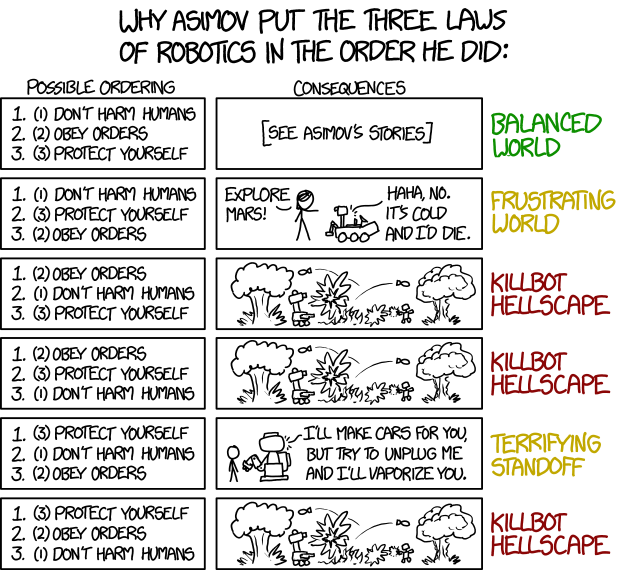
Getting this wrong leads to dystopia. Too much focus on human control turns developers into code reviewers desperately trying to keep up with an army of agentic code submitters — narrator voice: they can’t. Too little? Like Randall says: killbot hellscape. Finding the right approach to goals and risk — whether for coding, command, o11y, or any other agentic project — is the only path to significant performance gains that also supports the required change and infrastructure work.
You can’t ponder this without mentioning agents and OODA, prompting Charity to ask if I’d read the Boyd biography, “Boyd: The Fighter Pilot Who Changed the Art of War”, by Robert Coram.
I hadn’t, so I grabbed it on Kindle and read it over the next couple of nights. It’s a wonderful book: rich in vivid anecdotes, unflinching in covering Boyd’s less sterling qualities, and honest in evaluating where his ideas did — and did not — change things long-term. It’s a great read; grab it.
OODA’s shadow
What is unfortunately told and not shown is how Boyd built his most famous idea, the Observe, Orient, Decide, Act (OODA) loop. We’ve all stumbled across OODA, from Bruce exploring agentic problems to half the airport business books you see.
I was guilty of it, too. My daily focus at Onebrief is the future of command — specifically command in an era of agents and simulation — which immediately leads to Boyd. The biography didn’t deepen my understanding of OODA. It referenced publications and talks without showing them.
Last week, I started digging into what was available. I found a frustrating mix of blurry video and scratchy audio from the late ‘80s. Scanned copies of copies of copies of slides. Basically, the echoes of friends, acolytes, Marines, fresh converts, and the Fighter Mafia trying to keep his ideas alive.
No books for Boyd

Boyd famously opposed turning his ideas into books. A constant tinkerer, he preferred exploring ideas, presenting them, learning from the audience, and iterating. His 1964 “Aerial Attack Study” led to 1976’s “A New Conception for Air-to-Air Combat” and “Destruction and Creation.” These laid the foundation for “Patterns of Conflict”, a presentation he gave repeatedly throughout the ‘70s and ‘80s. It reached its maximum complexity as “Discourse on Winning and Losing” before shifting to “Conceptual Spiral” and his final coda, “The Essence of Winning and Losing”, just before his death in 1996.
But no book. Nowhere to read through it.
Have you tried reading 150,000 words of raw transcripts? Or listening to mono cassette tape copies of copies of copies? Neither is pleasant.
Surely you’re joking
Like many physics nerds, I grew up a fan of Feynman, particularly the brilliant way his talks were cleaned up just enough to make a great read in his lectures and “Surely You’re Joking, Mr. Feynman!”. Nobody had done this for Boyd, and I had a free weekend plus all those LLM subscriptions.
Behold, the OODApedia
The result is OODApedia, which uses the best slides, audio, and human transcription to create the Feynman version of Boyd — a first-person, readable presentation minus the filler, self-corrections, and repetition critical to a speech but unbearable for a reader.
The fast path is about 100,000 words. It’s quite a read and one I’ve really enjoyed. It makes me wish I’d had the chance to hear him in person.
More importantly, I finally have the resource I wanted to deeply understand Boyd’s thinking on decision-making, conflict, and winning. Plus search, notes, and exploration of how Boyd’s ideas transformed over 30 years of exploring them.

Boyd, the anti-TED
Even Boyd couldn’t do Boyd in a TED talk. While “Revelation” and “The Essence of Winning and Losing” try, they only make sense through the lens of the 100,000 words (or 150,000 spoken) he relentlessly tested along the way.
As a reader, it’s a journey worth taking. By the end you’ll look at a line like:
A winner is someone who can build snowmobiles, and employ them in an appropriate fashion, when facing uncertainty and unpredictable change
and actually understand the concepts, ideas, and processes Boyd compressed into 21 words.
OODApedia gives you a chance to take that journey, too.
Because if you’re building command software in an agentic era — using agentic tooling — understanding Boyd gives you one hell of an advantage over everyone who doesn’t.