Latest ·
This is the story we're telling?
Onebrief aligns with the government fiscal year — you haven’t really focused on “continuing resolutions” or “supplementals” until they control how you get paid, but that’s a story for another day — so I’m traveling ahead of 2027 budget and planning work. That meant I was in a hotel, with the NFL on in the background while thinking through priorities and goals.
Which meant I saw AI ads. A lot of AI ads. Ads tell you a lot about how companies think about themselves and their product. I think this Microsoft Copilot one is being particularly honest. Microsoft calls it “Competitive.”

Here’s the gist:
Kyle is secretly competitive.
Kyle’s coworker Daniel’s forecast model was better. People were praising it in public.
Kyle asks copilot: “Analyze Daniel’s model in the All Hands channel. Use it to make mine better.”
Kyle gets praise. Kyle is better than Daniel.
Are you kidding me? Though, I suppose given Manu’s timeless corporate culture cartoon, it sort of makes sense.
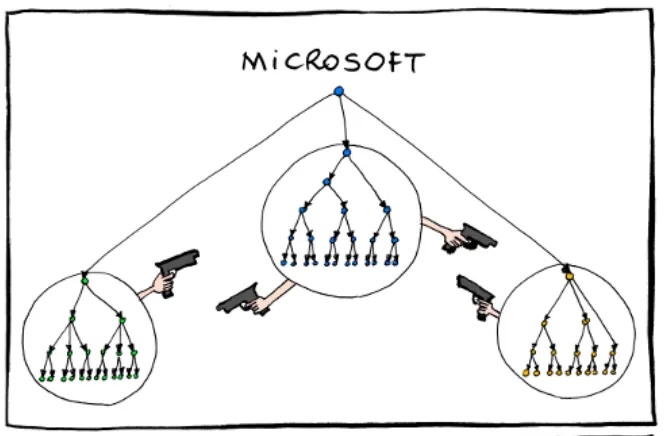
I’ve written before that AI is what you make of it. That navigating the outrage machine requires a higher bar for all of us working on this technology.
Instead, Microsoft chooses an ad campaign with the entire message being:
AI will make it easier to steal from colleagues and win
AI needs to make teams better, not worse
Greg Kroah-Hartman has a deliciously opinionated video discussion of the impact of AI to Linux kernel maintainers. It’s worth a watch. It does a very nice job of cutting through marketing hype and highlighting the very real load that naive — and not-naive — use of AI puts on our most critical roles.
Most importantly, even at his most dismissive of LLMs, Greg’s talk recognizes that they are moving us out of a world where good enough security is good enough. As he calls out, the mean time to exploit has gone from 63 days in 2018 to -7 days (that’s, negative 7 days) today.
The traditional discover -> disclose -> patch -> deploy cycle was designed for a slower adversary, that adversary no longer exists.
We have to write more, better code. And do it now.
Fortunately, Greg’s story is also one of very mature tooling. The Linux kernel team has been improving their processes for a long time, so they’re more ready than most for the next doubling (or, in 12 months, the nearly order of magnitude change) in AI capabilities.
But it’s also a story of slop grenades, spam on channels, and all the bad parts of AI putting load on people and systems.
This rhymes with Cloudflare’s call to action to build the next github our lesson. Our tooling needs to be better not just than today’s AI, but AI 1 or 2 orders of magnitude more capable.
And that tooling needs to be multiplayer, to make the teams using it better.
Teams that work together
Which is why the Microsoft ad was so frustrating. At a time when Americans view AI less favorably than ICE or Gavin Newsom, when most companies and teams are struggling to properly engage with AI, your message is “AI will let you crush your colleagues?”
We’re fortunate at Onebrief to have spent most of a decade working on staff collaboration before we added AI to the mix. It helps remind us that even as frontier models advance, no matter your use case if you aren’t focused on collaboration with teams of people and agents, you’re going to run headlong into tooling, communication, and process issues that overwhelm any efficiency gains AI might otherwise offer. Fortunately, that’s what we build. And we’re hiring.
Or, sure, you can spend time building tools to steal from your colleagues.
Previously
-
FlowAI
As I've written before, I don't find blanket AI objections to be particularly compelling.
-
What are you prepared to do?AI
With the July update, I talked about the very real gains we had seen at Onebrief by adopting an Outcome Engineering mindset, by focusing on using agentic AI res
-
Outcome Engineering, the July UpdateAI
It was never about the code is an even more important realization six months after I originally published the Outcome Engineering Manifesto.
-
Beyond guessingAI
Building products requires a strange mix of hubris and humility.
-
Many orders of magnitudeAI
People struggle to really understand order-of-magnitude changes.
-
The 'what do I do?' postAI
Charity has a trio of lovely AI posts up, "AI enthusiasts are in a race against time, AI skeptics are in a race against entropy", "AI demands more engineering discipline.
-
Multiplayer to the coreAI
Principle 3 of the Outcome Engineering Manifesto is Teamwork: No More Single Player Mode Chat is a bottleneck, not an API.
-
Failure and learningManagement
A question I often get from direct reports is roughly: I watch you set people up to take action on their own, even if it seems like they're going to fail.
-
Sometimes even the easy things are hardApple
My formative programming experiences were mostly early Apple machines.
-
Start using agents to harden your code NOWFirefox
If you build software for a living, go read Brian Grinstead, Christian Holler, Frederik Braun's article "Behind the Scenes Hardening Firefox with Claude Mythos Preview" right now.
-
Begun, the Agentic War hasThe Clone Wars
Happy Star Wars day, everyone!
-
It's in the way that you use itAI
AI is enabling the greatest learning opportunities humanity has ever experienced.
-
Understanding Boyd in just 100,000 words (or more)AI
It started with a conversation with Charity.
-
LaggardsAI
Steve Yegge has a devastating post up on X.
-
Project GlasswingAI
And hours after posting about how ill-prepared we all are for the cybersecurity implications of agentic AI, here comes Project Glasswing.
-
It only TuesdayAI
What a week already in the AI and agentic world.
-
Open world on the Nintendo 64Road Rash 64
Thanks to a Hacker News thread about an impressive open-world demo, I have been taking a stroll down memory lane.
-
Surfing, Continuous Improvement, and AISurf Simply
I've written about surfing before but had neglected to mention the most excellent Surf Simply in Nosara, Costa Rica.
-
Innovation and National SecurityNSIB
Last week, I traveled to Washington, D.C., to attend the Ronald Reagan National Security Innovation Base Summit, which the Reagan Foundation hosted.