· 3 min
Laggards
Steve Yegge has a devastating post up on X. He was talking to a friend about AI adoption at Google:
The TL;DR is that Google engineering appears to have the same AI adoption footprint as John Deere, the tractor company. Most of the industry has the same internal adoption curve: 20% agentic power users, 20% outright refusers, 60% still using Cursor or equivalent chat tool. It turns out Google has this curve too.
This curve is why I wrote the Outcome Engineering Manifesto. Because, of course Google has this distribution.
I spent five years in the business of change at Google. I thought the Facebook mobile transition had prepped me for how hard change is. I was so wrong. Why is that? I write about change a lot and there are the obvious, normal reasons — like people forgetting that different isn’t always better, but better is always different. Also:
- People and teams would rather fail doing normal things than succeed doing weird things
- If you checked out agentic coding a year — or even 6-months ago — you completely missed what has changed lately
What makes change even harder at Google? Ironically, incredibly smart people who’ve spent their whole careers kicking ass at Google.
It’s part of why Google discounts non-Google work to zero1 (even if your work was absolutely trouncing them at mobile for years).
No matter how complex you think Google is — organizationally, infrastructurally, technically — you are underestimating reality. Nearly 30 years of hiring the absolutely smartest people on the planet (let’s be clear — Google’s talent level at scale is unprecedented) and giving them free rein to build means a degree of clever, bespoke nerdiness that has to be experienced to be believed. In many ways, it’s awesome and has generated a style of tech island that has helped Google survive many a supply chain attack that has seriously hammered other hyperscalers.
Naturally these luminescently intelligent people are often inward-facing, heads down, and focused on what’s in front of them. If they pop their heads up, they’re often engaging with other, busy, inward-facing Googlers navigating immense complexity.
And that incredible mental horsepower has always been disproportionately poured into “But, actually...” commentary at Google.
As the man once said, Google culture is “commit, then disagree.”
(And at many points in Google history, this has paid off!)
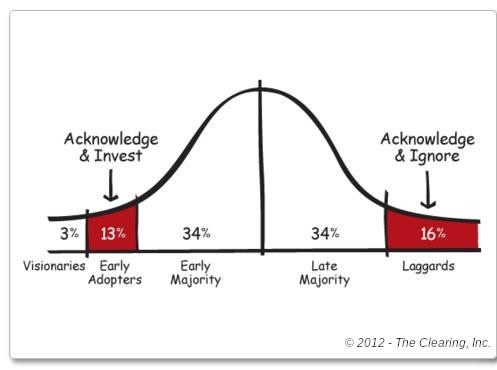
But it means you have the PhD, virtuoso, Guinness World Record-level laggards. Remember, laggards look a lot like visionaries. They’re super smart, they ask lots of questions. The difference is that they never change their positions and use all of their capital and brilliance to draw attention to their objections.
Because Google is also a generally very nice place, it makes ignoring the laggards a bitch to pull off. I have the scars. And it’s why it generally has taken fearless outsiders to drive change at Google.
Unfortunately:
...it’s the Great Siloing. Everyone’s flying blind. With nobody moving companies, no company knows where they stand on the AI adoption curve. Nobody knows how they’re doing compared to everyone else.
You turn off hiring, reduce new leaders, and suddenly where does change come from?
During my Noogler orientation, I was assigned a VP (soon to be SVP) for lunch. This person proceeded to Googlesplain mobile engineering, product development, games, and social to me over lunch. It was a remarkable — not in a good way — experience. ↩