OpenAI's Path to Search Ads
OpenAI just announced their app platform. The obvious comparison is early Facebook but I expect the more important comparison is to Google’s search ads.
DevDay
I attended OpenAI’s DevDay in San Francisco1. I was stoked to find my name front and center at the start of the keynote. We’ve used a few tokens over the last two years.
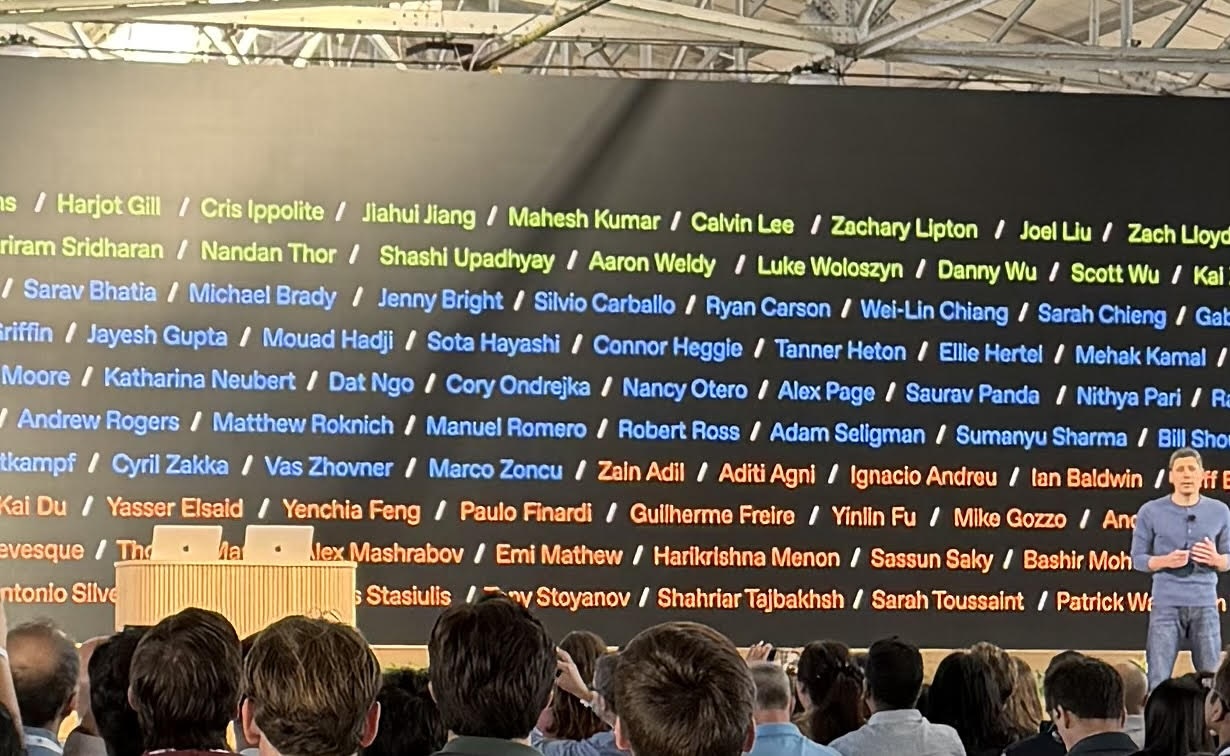
What I didn’t expect was the degree to which OpenAI feels like 2010 Facebook. DevDay was the 2025 version of F8.
OpenAI might be more Facebook than Meta
First, the people. You couldn’t throw a stone at DevDay without hitting a 2008-2014 Facebooker, particularly the core people who did the work from the start of Platform through the mobile transition. They were everywhere at Fort Mason. Designers, execs, engineers, marketers… you name it. I knew many former colleagues had joined OpenAI, but seeing them all in one place drove the point home. But it wasn’t just the people; the presentation itself felt like a throwback to Facebook’s early days.
Second, Sam’s keynote. This could have been Mark at F8 2007. Casey Newton spotted it as well. His article is worth a read, though it makes a different Zynga point than I would.
Like Facebook did, OpenAI is launching its platform without a settled strategy for generating revenue. Facebook would eventually begin offering its own currency, Facebook Credits, and require popular applications like Zynga’s world-beating FarmVille to use it for transactions. (Facebook took a 30 percent cut; Zynga alone once accounted for 12 percent of all Facebook revenue.)
While Newton makes the point about payment systems — after all, we now live in a world of app stores and 30% cuts — that framing is flawed because in two ways:
- The 12% figure included both advertising and payments, but advertising was wildly more important to Facebook
- It was referencing 2011, before Facebook started reducing Zynga’s prominance on News Feed
Does this sound familiar? Highly engaging content demands attention and drives ad revenue, but it’s ultimately so damaging that the platform owner must make dramatic changes to content ranking. This is exactly what I talked about in “Rethinking Attention.”
The goldrush problem
The first few months of the new ChatGPT app platform is going to be glorious. Like Facebook’s platform2, there’s going to be broad exploration by creators but supercharged by the ease of using Codex — or other coding tools — to “make me a ChatGPT app!” Much like the early Werewolf games on Facebook’s platform, some mechanics will inevitably hijack OpenAI’s attention and discovery models. Once that happens, we’ll be off to the races. Some company will be better at understanding and scaling those experiences and et voila an OpenAI Zynga will arise.
And like Zynga/Facebook, in all likelihood this company will have misaligned incentives with OpenAI.
OpenAI will decide whether they are Google or Apple in terms of App Reviews. Given the incredibly broad privacy and security risks AI agents expose people to via the lethal trifecta, I expect OpenAI to choose the Apple model and likely have spectacularly rough failure cases anyway. Especially with the wannabe Zyngas looking for any angle to get attention and discovery advantages. And that min/maxing attention and discovery will certainly reduce the overall experience of using ChatGPT. Agentic coding tools mean that every namespace and keyword will be squatted on, and every discovery channel will be hammered. Suddenly every potential action in a quesiton to ChatGPT will have thousands or millions of potential matches that need prioritization and ranking.
Which is where they’ll need search ads.
Search ads: the results you didn’t know to ask for
Twenty five years into Google, it’s easy to forget how magical and transformative search ads are. At a moment when you — as a user — have commercial intent, the big Google machine delivers you something even better than the answer to your search query: a shortcut to buying the thing you were curious about. Compared to display and brand advertising, search ads have two incredible advantages: they deliver right at the moment you are considering a purchase (making you more likely to click on it, increasing its value dramatically) and they require practically no personal information, so they’re a lot less creepy than display ads following you around the Internet.
There’s been a lot of chatter about ChatGPT’s inevitable collision with Google around search ads, but like the limitations of Facebook’s early version of News Feed and exclusively social ads, it wasn’t clear to me how ChatGPT was going to generate the volume of commercial intent to make them viable.
Now we know. Exciting times ahead.
Footnotes
-
The last time I was at an event at Fort Mason was for the second Second Life Community Convention, which is perhaps a worthwhile side conversation about irrational excitement and bubbles. ↩
-
Another nit with Newton: 2007 was social graph, which is what mattered for the Facebook platform. Open Graph came along later, in many ways a reaction to the News Graph havok simple social graph experiences were wreaking. ↩