The Clock is Ticking
A recent The Press Box podcast itched at a question that drives our commitment to NewsArc and journalism that matters. Joel Anderson was talking about what took him into journalism and said:
I think there’s this assumption that people are waiting on, they’re going to be waiting on us when this is over. Like if we ever get through this moment in history, that they’re going to be waiting on us and they’re going to come back. The Washington Post is going to get all their subscribers back and people will forgive them because they’ll do some good reporting or whatever, but I don’t think so, man. I don’t think people are going to be clamoring for our work if we keep going in this direction, if we keep to your to use your phrase, bend the knee. Like I don’t what we will have not earned the public’s trust. We’ve already sort of lost it, but there will be nothing there for us if we keep going down this road, I think.1
There will be nothing there for us. This is the question anyone who cares about democracy, facts, and science should be asking themselves: how much abuse can the news ecosystem take in the forms of anti-journalist propaganda, self-censorship, and low-quality attention ranking before it is permanently damaged?
No rose-colored glasses here
The news business also shares the blame. When you’re a classifieds business with a journalism side hustle, Craigslist is going to eat your lunch. Same story if you decide to build a house of cards on traffic.
But the decline in trust should be what’s actually worrying everyone.
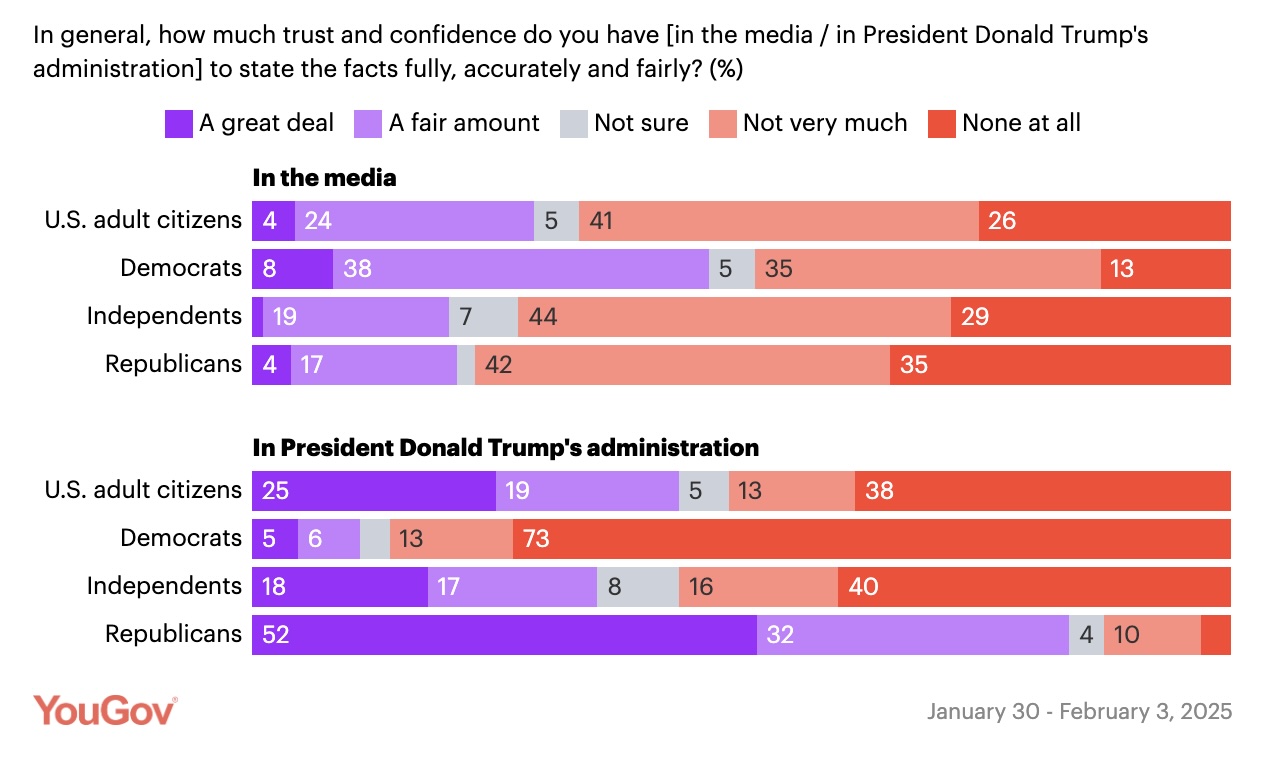
I don’t know if the data is clear around which direction causation’s arrow is pointing, but at the very least, the decline in trust in news and media is correlated with broader societal trends around radical decreases in institutional trust. Everywhere you look, we’re at least 25 years into systematically teaching people not to trust facts, experts, or news.
Tech plays its part
I’ve written a lot about the implications of attention reinforcement, outrage, and advertising. Pete and I talked about it on his podcast. Bryan Curtis keys into this:
I worry it’s too late already. I worry even if we stopped all the bending of knees right now, if we called a halt to all knee bending from any corporate parent of of journalism, that it’s just everything’s been so broken, so stigmatized. You know, there’ll be a need for journalism. Like there will be people in the world that be like, I want to read that. I want to learn more. I want to learn something like the truth or the closest that you, the reporter, can get me to the truth. There will be certainly people who want that in all walks of life, right? Not just politics. But it does feel like something has, something has changed over the last few years, married to the change in technology, where you now have all these ways to get information, quote unquote information, right? Like those two things happening at the same time is an illness that we as a media broadly speaking are going to be, it’s gonna be very, very hard for us to overcome that.
It’s hard to build technology for a living and listen to quotes like this, and it’s easy to just disagree, to nitpick. “Oh, it’s not just the technology.” But it’s clear technology has played a part. It’s why NewsArc is doing things so differently.
Building a path forward
I think it starts with a cold, hard look at the data. While Curtis is quick to point out that some people aren’t going to care about journalism:
Those people aren’t going to buy the newspaper. Like the whole, no, no, no, they’ve been trained not to trust the newspaper and it’s like, oh, now they’ll buy it if we put our people in charge of the newspaper, if we if we change the complexion of the opinion section. That’s not going to happen. This is just not going to happen. Like you can’t be like, everything on CBS is a complete lie. Oh, there’s a new administration, check out CBS.
But if you dig into how Americans engage with news — thank you, Reuters Digital News Report — you keep finding some amazing things:
- 20% of Americans pay for news (that’s 50 million adults)
- 31% share news in a month (that’s 80 million)
- Almost 50% say they would pay for news podcasts
If you dig into the demographic data, those don’t look like the same groups. In addition, other surveys point out that American news consumers cross shop news sources and say they want a way to understand the complete picture.
But we’d be foolish to think we have infinite time to reach them. Not just because of the consumers — how many kids today (insert old man yelling at clouds meme) are thinking like Anderson did:
I was inspired, like, on my wall, I have the three books above me that inspired me the most. Friday Night Lights, The Warmth of Other Suns, and the collected works of Ralph Wiley. That’s the stuff that made me want to do this. And it motivated me to want to tell stories about people that normally don’t get stories told about them and go to places that I’ve never been and tell the stories of those places.
We need brilliant people burning to be journalists. A vibrant market that supports them. And news readers who want to understand what’s happening in the world around them.
I still believe technology is part of the answer. Check out NewsArc and see if you agree.
Footnotes
-
I couldn’t find an official transcription, so I generated these with a vibe-coded Gemini pipeline. I’ll write up what I learned about that tomorrow. ↩