Traffic is the wrong business model for news
The most recent of the Press Gazette’s monthly updates on traffic to the top English-language news sites is making the rounds in the tech and news communities. The top-line stats are bleak:
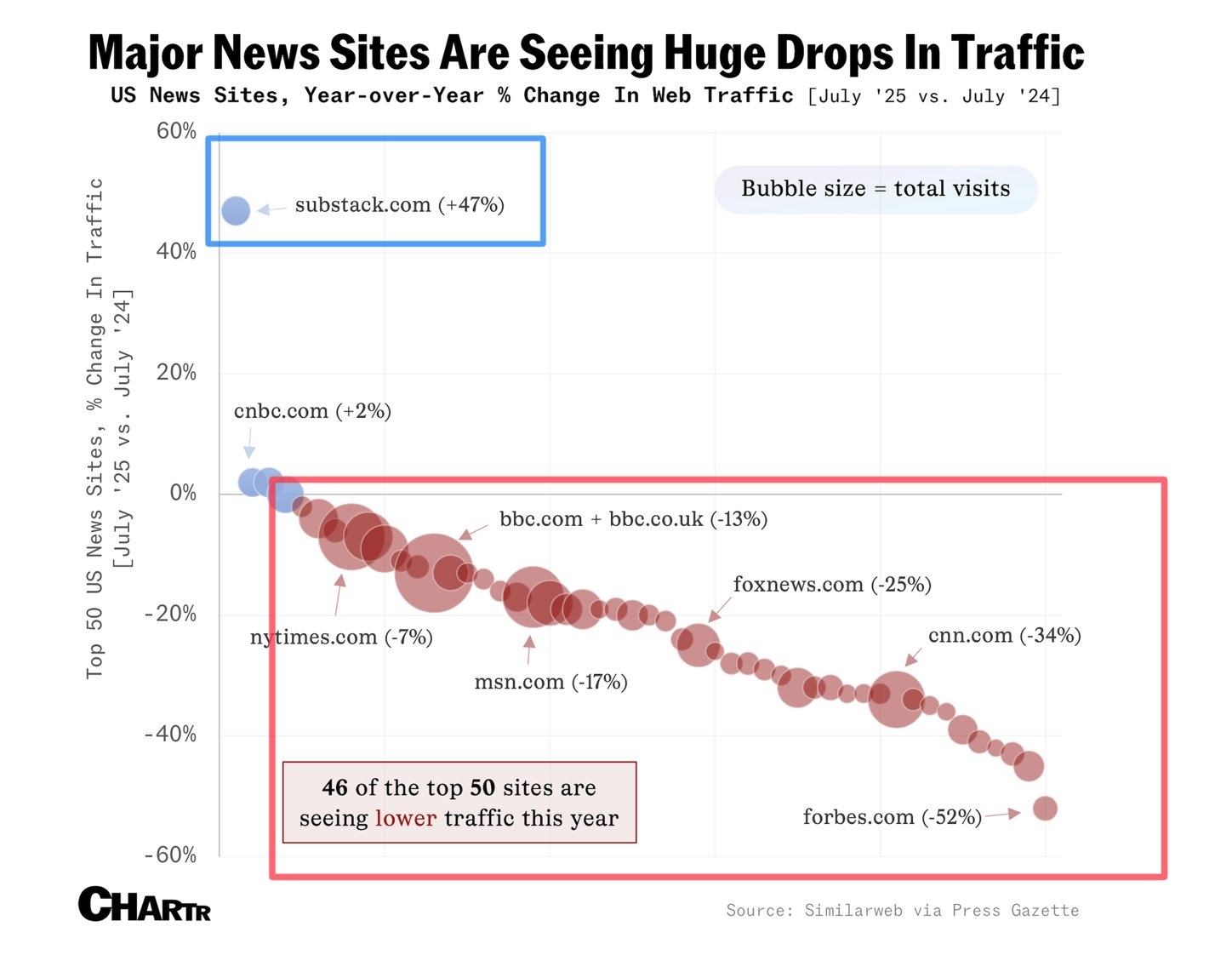
All but four of the 50 biggest English-language news websites in the world saw their monthly visits drop in July compared to the same month a year earlier.
The vast traffic declines across the board included all ten of the biggest sites in the world, according to the latest Similarweb data. The biggest drop among the top-ten sites was CNN, down 33.6% to 471.6 million visits in July.
Substack was the only site to see double-digit year-on-year growth in visits and was up 46.9% to 125.2 million in July.
The Press Gazette reports in table form, but some helpful folks put it on a chart (a weirdly one-dimensional chart, but a chart nonetheless).
Not a new issue
For the last 15 years, the conversation around the internet—particularly for news—has been dominated by traffic. Particularly as we saved mobile at Meta, online discussion at the time focused on the incredible traffic changes we were driving. News publishers had already been tracking the swing from Google search traffic to shared links on Facebook, but suddenly the traffic was switching to mobile and varied wildly as we explored different ranking and link choices.
The wild increases and variances of 2005-2014 changed as Meta’s Instant Articles and Google’s AMP rolled out, massively changing the dynamics of traffic and referrals—despite both Meta and Google working hard to meet publisher requirements. On top of that, Google spent much of the last decade moving more and more search results into its OneBox, showing relevant results directly on the page rather than via links.
Then AI arrived. AI—in particular the immediacy of chat interfaces like ChatGPT and the upgrade GenAI has provided to Google Search—means even more questions, news, and information are immediately available to a user rather than through a link to the source.
Nobody should be surprised by this.
Incentives and UX disasters

Have you used a mobile website recently? I mean, really used one? I could have generated 100 example screenshots, but here’s one from a few minutes ago. The only person happy with this site is some PM whose bonus is tied to ad clicks.
Nobody who cares about their product and user experience wants their customers to land in this hellscape, and the easiest way to fix it is to render the content locally. If your deals are built around traffic, suddenly everyone’s incentives are misaligned, traffic is plummeting, partner revenue is dropping, and nobody is happy.
There’s a much better way. To their huge credit, the NY Times figured this out almost 15 years ago. Many smart thinkers predicted it would fail, but it has turned out rather nicely for the Times. Many branded news sites have followed, but it’s still unusual for aggregators.
News is worth paying for
From the earliest days of creating NewsArc, we knew the user experience would be key to how we respected our customers’ time and attention. By keeping the reading experience beautiful, fast, and expressive, we could help people discover the news that mattered to them every day. But that meant we couldn’t be bouncing people off NewsArc to other sites or depending on an embedded mobile web view. That meant we could never build our model on traffic; instead, we’d be paying publishers.
Crazy idea, I know.
Fortunately, we already agreed with the three C’s of using news content from publishers—credit, consent, and compensation—so working directly with great publishers was already aligned with our vision.
Sustaining the ecosystems around journalism means adopting aligned, healthy business models that can ensure great experiences and weather technological transitions. You might think that publishers—particularly newspapers—had already learned the lesson of depending on generating value from news-adjacent products (e.g., classified ads and Craig’s List). Traffic is great as one of many discovery tools. It’s also a lovely signal of broader success; see newsletters and Substack. But it’s not a dependable business model. Publishers and journalists would be smart to move past it.
Because journalism matters.