Surfing isn't about the other people
I am a late to life surfer. I wouldn’t claim to be a great surfer, but I can navigate the Absolutely Friendliest Surfing Location On Earth (Santa Cruz, CA), I don’t get called a ‘kook’ anymore, and I catch plenty of waves. I adore the sport.
It all starts with Point Break
I grew up in rural Massachusetts and Milwaukee, then went to college in Annapolis, Maryland. So while lakes and the ocean were a part of my life as long as I can remember, surfing was something I was barely even aware of and certainly not something I would have imagined ever doing. Then I met Johnny Utah and Bodhi1.
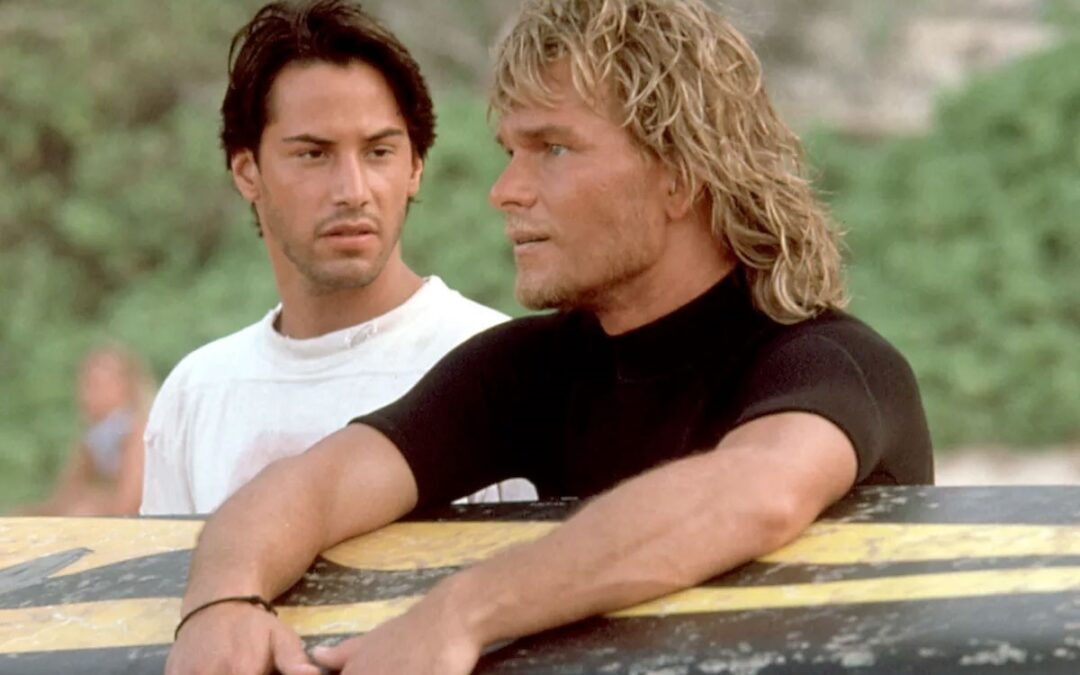
Like everyone, I adored the movie, thought all the surfers were about the coolest people imaginable, and filed it away in the “things I’d never do” (along with sky diving). While at Navy Nuclear Power School in Orlando, I realized sky diving was an option and did a single Accelerated Free-Fall jump. Despite being very uncomfortable with heights, jumping out of a plane — like rappelling — doesn’t bother me and I really loved the jump. Unfortunately, skydiving is expensive and by the time I was far enough along in my career to go back to it, being a parent, career, and weight gain all conspired to push it to the back of the line.
Then, in 2017, thanks to the Mark’s Year of Running I was in substantially better shape. I’d also spent 2010-2014 working closely with Javi. In addition to inventing the modern concept of growth engineering, Javi is an avid surfer and would often get to the office after a morning session. Javi made surfing seem awesome. I’d also spent enough time at Manresa eating David’s incredible food to watch his “Mind of a Chef” episodes, where Santa Cruz and surfing featured heavily. It all combined to have me thinking about surfing again.
So I tried it.
Surf instruction
Pretty much anyone who learns to surf in Santa Cruz either learns from — or gets yelled at by — Ed Guzman, the owner of Club Ed. Ed and his staff are lovely, though fairly typical of beginner surf instructors. They sort of teach you to lie on the board, push you into waves, and then celebrate if you get to your feet. It’s pretty much all just straight to the beach and questions about turning tend to get answered by “you’ll just feel it.” Fortunately, Iron Realms founder Matt Mihaly commented on one of my early posts with “go to Surf Simply.” Like a lot of beginning surfers, I’d already found Surf Simply because of their YouTube videos, but had never really considered it. I thought it was too expensive, the wait was too long, and I wondered how different it could really be.
I was wrong. Surf Simply is fantastic. Why it’s so amazing is a post for another day, but in short I think their approach to the pedagogy of surf instruction may be the best-structured instruction of anything I’ve ever experienced. Visits there have made me a substantially better surfer and connected me to a really lovely community as well.
It’s only drowning
On a recent trip, a fellow student recommended a surf book with an absolute gem of a title: “It’s Only Drowning” by David Litt. David’s book does a pretty good job of capturing the experience of learning to surf: the nerves, the stumbles, the injuries, and the all-consuming passion that surfing can trigger. What really stuck with me was a particular aspect of David’s experience: his constant comparison of his own performance to other surfers.
It’s a not uncommon framing — I’ve met plenty of surfers who think that way — but it’s not my experience. As my friend and spearfishing partner extraordinaire Brian Renfro likes to put it:
You know who had the best day surfing? The person with the biggest smile
I couldn’t agree more. One of my late-in-life discoveries is that I am fundamentally happier on, under, near, or in the ocean. A lot of the activities that I really love — surfing, free diving, spearfishing — are decidedly Type 2 Fun (that training and attention keep from becoming Type 3). The easiest way to make surfing — or anything else — not fun is to spend a bunch of time and energy comparing yourself to others.
The ocean doesn’t care about you
To me, it’s a lot like building products. Everything starts in a situation where nobody really cares. I can be wildly excited about NewsArc, be shouting from the rooftops about how it’s changing news for the better, but even for most of the readers of this blog, it’s not even on their radar — at least not yet :)!
The ocean doesn’t care about you.
That lack of caring is central to how I experience surfing and a big part of why I love it so much. Surfing has these different states that all have to work to end the day with a smile:
-
Arrival and studying the ocean. What’s the swell like today? How big is it? What’s the period? How is the tide and wind going to change it during the day. Is there a channel to paddle out or is it going to be a battle while waiting for a lull.
-
Once you’re out back, it’s about hunting. What is the ocean doing? How easy are peaks to spot? How much are they shifting as they form or colliding with secondary swells to fool you? How crowded is the lineup, are people stacked up waiting on the shoulder? If everyone’s looking for rights, is there a sneaky left to chase?
-
When you spot a peak that you either have priority on or think everyone else is going to miss — it’s pretty easy to back out of a wave late — you have to commit. Chasing a wave is a Deadpool-like, maximum effort kind of moment. You have to paddle with enough speed to match the wave right as the shoulder is getting ready to break, so that gravity can carry you down the face of the wave as the edge you set starts to generate lift and enables you to blast down the line or carve a turn. Full, 100% commitment while also watching for whether the wave is breaking faster or slower than you guessed, someone else is dropping in on you, you missed that someone else had priority (or the peak shifted enough to give someone else priority), the prior wave didn’t create a yard sale ahead of you, etc.
-
Then you’re flying. Now you’re up on the wave, blasting down the highline. Hopefully you already were watching the next wave section and have your first turn planned out, but no matter what this is the fun moment, the experience of ripping down a wave. Whether you head to the beach, bite it, or kick out, the next step is to do it all again.
Yup, this feels a lot like product development
These moments in surfing — study, hunting, commitment, flying — are pretty much exactly how I think about product development: how you identify a need or an opportunity, explore markets and potential customers, commit with strong opinions that are loosely held, and experience the excitement that comes when a product really takes off.
And just like with surfing, competitors don’t really matter. Sure, you get to learn from them — and it is lovely to have competitors exploring product ideas you don’t have time for — but comparing yourself to competitors is a losing game. Is your product reaching customers, sustainable, working? If so, keep making it better.
Of course, there are moments when the thrill of competition is motivating or exciting. Bulletin-board material isn’t just for professional sports teams. But there’s way too much going on with competitors you can’t control, so spending your team’s time and energy there isn’t going to help you win.
Are you and your users smiling at the end of the day? That’s a pretty good start.
Footnotes
-
Thank goodness nobody ever tried to make a sequel or remake of “Point Break,” since it’s perfect. ↩